
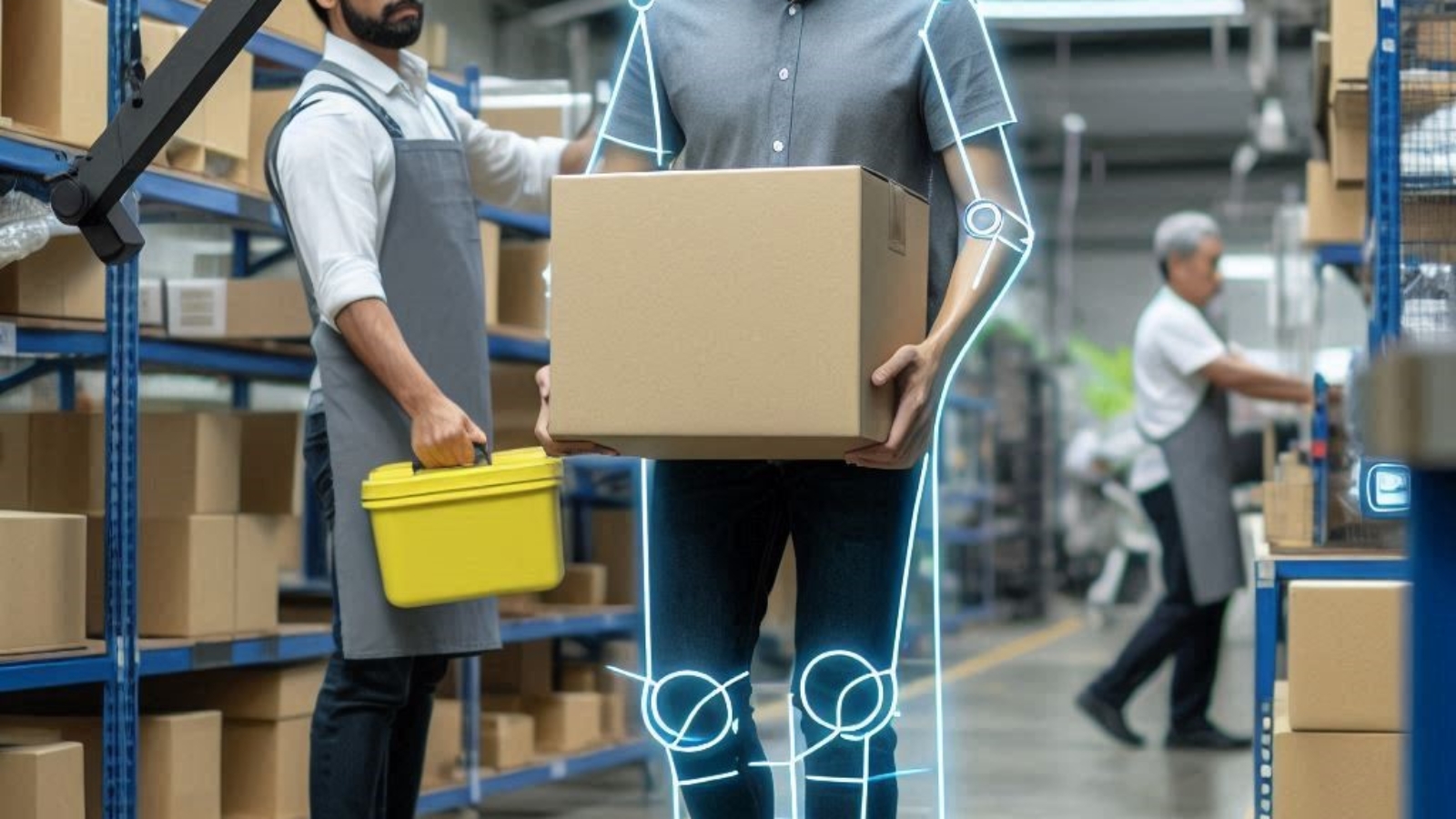
This paper addresses a key limitation in conventional ergonomic evaluations: they are often subjective, labor-intensive, and inconsistent. Traditional methods rely on human observers who may introduce bias or variability, and cannot offer continuous, automated monitoring. To overcome these limitations, the authors propose an AI-powered ergonomics framework that performs real-time posture detection and classification to reduce the incidence of musculoskeletal disorders (MSDs) in workplace settings.
Methodology & System Design
The framework uses TensorFlow MoveNet, a pose estimation model, to extract anatomical keypoints (e.g., shoulders, hips, knees) from video frames, capturing human posture continuously. These keypoints serve as input to a Random Forest classifier, which categorizes posture into one of four classes: “sitting appropriate,” “sitting inappropriate,” “standing appropriate,” and “standing inappropriate.” To validate the AI predictions, the authors also employ wearable inertial sensors (e.g. IMUs) placed on the lower back and shoulders for cross-verification.
Findings & Results
In controlled test environments, the system achieved 100% classification accuracy distinguishing correct vs. incorrect postures. In real-world deployment across different workplace settings (e.g. offices, manufacturing), the model recorded meaningful improvements in ergonomic compliance:
- Workplace injuries reduced by approximately 25%
- Self-reported discomfort dropped by around 30%
These results demonstrate that integrating AI-based posture detection into standard safety protocols can yield tangible health and performance benefits for workers.
Challenges & Limitations
Despite promising results, the authors acknowledge several barriers to broader adoption:
- Data privacy & surveillance concerns: The use of continuous video monitoring may raise ethical and legal issues in workplaces.
- Generalization limits: Models trained in one environment may struggle to adapt to different lighting, body types, camera angles, or work contexts.
- User acceptance & adoption: Workers and organizations may resist being monitored or distrust AI judgments.
- Technical robustness: Ensuring the system remains reliable across diverse real-world conditions (occlusions, movement noise) is nontrivial.
Conclusion & Implications
The study concludes that AI-powered posture detection systems represent a promising, scalable tool to enhance workplace ergonomics. When combined with training, policy, and ergonomic design improvements, these systems can help shift ergonomic evaluation from reactive to proactive. The authors recommend further longitudinal studies, extension to more complex tasks, refining robustness, and careful handling of privacy and human factors to advance adoption.
Source : https://www.researchgate.net/publication/389610617_AI-Powered_Ergonomics_Enhancing_Workplace_Safety_through_Posture_Detection
Add a Comment